In this article
Few decorative traditions are as instantly recognisable as Portuguese blue and white tiles. Walk through Lisbon, Porto or almost any Portuguese town and you will find them on church walls and palace corridors, in shops and stairwells, and in the entrance halls of ordinary houses. Known as azulejos, these glazed ceramic tiles have been part of Portuguese architecture for more than five hundred years, and cobalt blue on a white glaze has become the look most closely associated with them.
This article explains where that look comes from, why it has endured, and how to use blue and white tiles in a contemporary home without turning a room into a museum piece.
A short history of the azulejo
The word azulejo is usually traced to the Arabic al-zulayj, meaning “polished stone”. Despite the resemblance, it does not come from azul, the Portuguese word for blue, and the first azulejos used in Portugal were not blue and white at all.
In the late fifteenth and early sixteenth centuries, Portugal imported glazed tiles from Seville. They were made with Hispano-Moresque techniques known as corda seca and aresta, which kept coloured glazes apart with lines of a greasy compound or with raised ridges moulded into the tile. Some of the finest surviving examples line the rooms of the National Palace of Sintra.
During the sixteenth century the Italian majolica technique reached the Iberian Peninsula. Painters worked directly onto a raw white tin glaze before firing, which made detailed, painterly designs possible. By the second half of the century Lisbon had workshops of its own, and in the seventeenth century church and palace walls were covered in repeating “carpet” patterns painted mainly in blue and yellow on white.
How blue and white took over
From the late seventeenth century, taste shifted decisively towards blue on white. Chinese porcelain, which Portuguese merchants had been bringing to Europe since the sixteenth century, and tiles imported from the Netherlands both helped to popularise the palette. In the early eighteenth century Portuguese painters produced monumental figurative panels in blue and white, from sweeping landscapes to hunting scenes, during a period historians call the Ciclo dos Mestres, the Cycle of the Masters.
After the 1755 Lisbon earthquake, simpler repeating patterns were produced in quantity for the rebuilding of the city, and in the nineteenth century new industrial methods made patterned tiles affordable for ordinary townhouses in Lisbon, Porto and beyond. Today the National Tile Museum in Lisbon, housed in the former Convent of Madre de Deus, traces the whole story.
Why cobalt on white still works
The appeal is partly practical. Cobalt has long been one of the most stable colours in ceramics, and blue and white panels installed three centuries ago are still vivid today. A white glazed ground also reflects light back into a room, which is one reason these tiles have always been popular in stairwells, corridors and kitchens.
It also works visually. Blue sits comfortably beside almost every material a home is made of: oak and walnut, marble and limestone, brass, linen, terracotta and painted plaster. It reads as calm rather than loud, even in a dense pattern, so a fully tiled wall still feels relaxed.
Original designs, precision-made
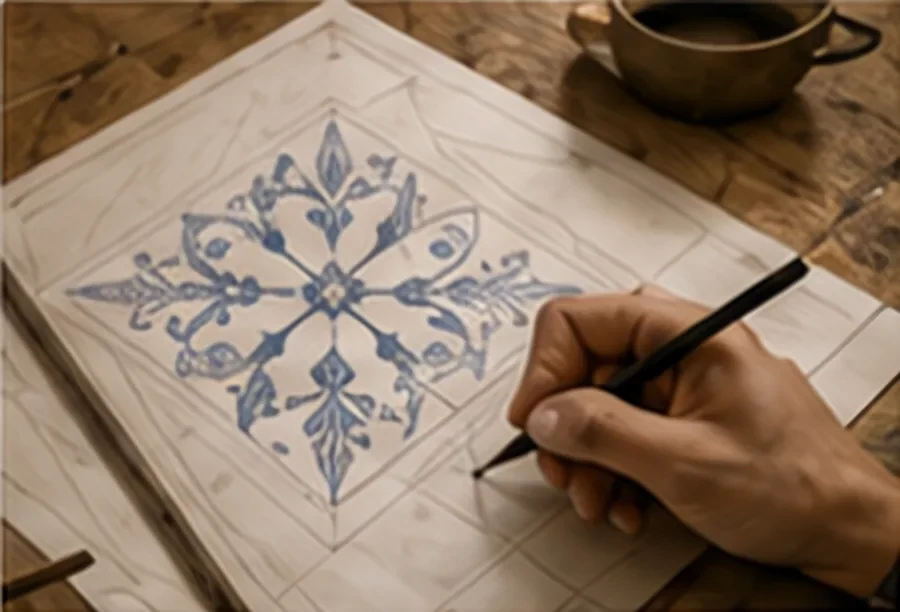
Historic azulejos were painted with a brush, and the great panels of the eighteenth century still show the individual brushwork of the painters who created them. Bassani’s brings that visual language into contemporary homes in a different way.
Every Bassani’s design is an original by Claudio Bassani, our founder, created in his studio in Belmonte and inspired by Portugal’s azulejo heritage. The tiles are produced by machine for consistent colour, size and finish, so each pattern lines up cleanly from one tile to the next and a whole wall reads as a single, considered composition.
Ways to use blue and white tiles today
Blue and white tiles are versatile enough to cover a whole wall or to act as a single accent. Some of the most successful approaches:
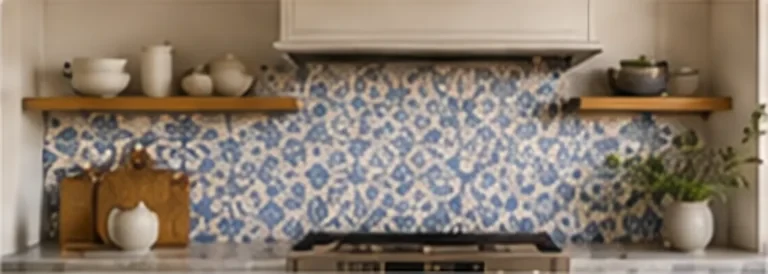
- The kitchen backsplash. The classic application: a band of pattern between the countertop and the cabinets, framed with a border for a finished edge.
- A bathroom feature wall. Tiling the wall behind a bath or basin from floor to ceiling creates a focal point while the rest of the room stays quiet.
- The fireplace surround. Glazed ceramic is non-combustible and easy to clean, and a blue and white surround gives a living room instant character.
- Entrance walls and stair risers. Small areas seen at close range are ideal for the most detailed patterns.
- Pattern with plain. Pairing a patterned field with plain white or navy tiles lets you control how much pattern the eye takes in.
Choosing a design from the Lisboa Blues collection
Our Lisboa Blues collection gathers our classic cobalt-on-ivory designs, each with its own character. Lisboa Blue is inspired by eighteenth-century baroque azulejos: four tiles meet to form a sweeping medallion of acanthus scrolls that links into a lace-like pattern across the wall. Cascais Blue is bolder, a four-petal bloom framed by scrolling leaves. Coimbra Classic has a dense, all-over pattern that reads almost as a woven surface, while Belém Rosette is the most restrained of the group, a crisp rosette whose open corners join into a flowing lattice.
As a rule of thumb, large medallions suit bigger walls where the full repeat can be seen, while tighter patterns work well in small spaces viewed up close. If you are torn between designs, book a free design consultation: share photos of your room and our team will help you choose. Like all Bassani’s tiles, the Lisboa Blues designs are for interior use only and are not suitable for outdoor installation.
Quick answers
Why are Portuguese tiles blue and white?
The earliest Portuguese tiles were multicoloured. Blue on white became dominant from the late seventeenth century, influenced by Chinese porcelain and Dutch tiles, and it reached its height in the large painted panels of the early eighteenth century.
What does azulejo mean?
Azulejo is the Portuguese word for a glazed ceramic tile. It is usually traced to the Arabic al-zulayj, “polished stone”, rather than to azul, the Portuguese word for blue.
Do blue and white tiles fade over time?
Glazed tiles hold their colour well: historic blue and white azulejos installed centuries ago are still vivid today. Clean the tiles with a pH-neutral cleaner and look after the grout, as described in our tile care guide.