In this article
Portuguese tiles are, above all, an art of pattern. For five centuries, tile makers have explored how a single square can join its neighbours to form stars, rosettes, lattices and flowing vines that seem to have no beginning or end. Understanding how those patterns work, and how they were used historically, is the key to using them well today.
How a tile pattern works
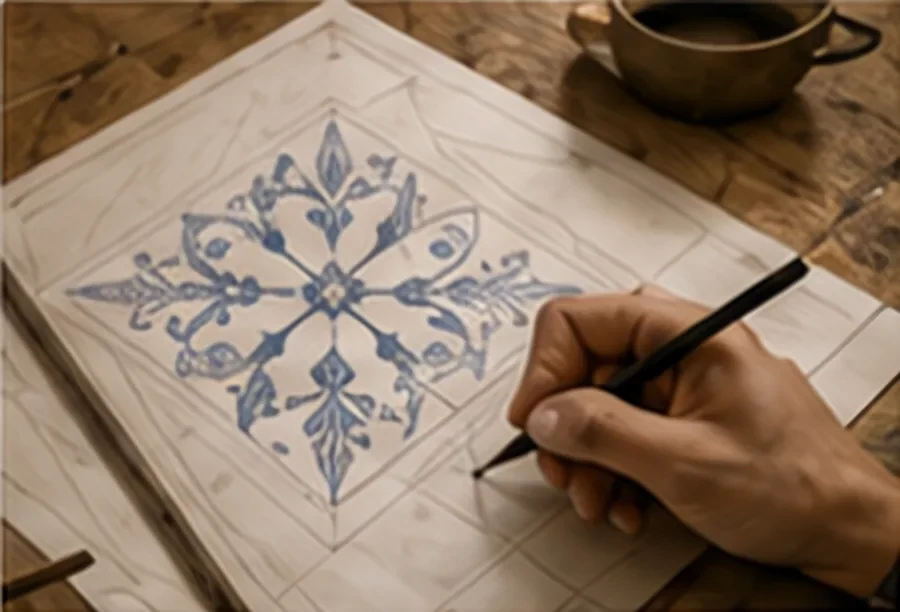
Traditional Portuguese pattern tiles, known as azulejos de padrão, are designed as part of a module. A single tile may carry a complete motif, or only a quarter of one, so that four tiles meet to form a medallion; larger modules extend the repeat across 16 tiles or more. In some designs the medallion is created by rotating identical tiles, so the orientation of each tile matters.
Repetition was also practical. A single design, repeated, could cover a large wall with far less painting than a figurative panel, and the same tiles could be arranged to fit rooms of any size or shape.
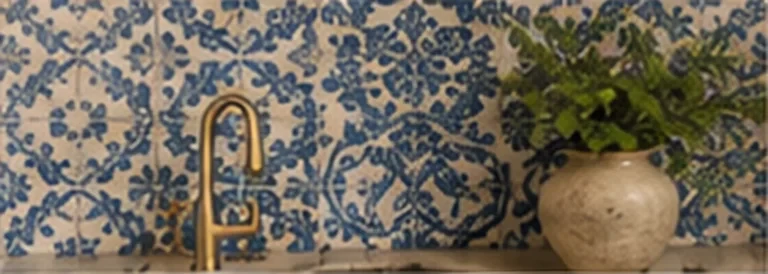
When the module repeats across a wall, secondary shapes appear where the modules touch: a star between four rosettes, or a lattice formed by the corners of every tile. Good pattern tiles are drawn so that these secondary shapes are as satisfying as the main motif. Our Lisboa Blue tile is a clear example: four tiles form a baroque medallion of acanthus scrolls, and a field of them links into a continuous, lace-like surface.
Traditional motifs and where they come from
Geometric stars and interlacing
The earliest glazed tiles used in Portugal came from Seville and carried the geometric vocabulary of Hispano-Moresque art: interlacing bands, eight-pointed stars and polygons. That geometry has never disappeared from Portuguese design. Mouraria Star, an eight-point star in terracotta and olive, takes its name from Mouraria, Lisbon’s historic Moorish quarter.
Carpet patterns
In the seventeenth century, church and palace walls were covered in repeating patterns that recall woven textiles, known as azulejos de tapete, or carpet tiles. Painted mainly in blue and yellow on white, they were usually framed with borders, just as a rug is edged.
Rosettes, vines and flowers
Botanical motifs run through the whole history of the azulejo, from stylised rosettes to acanthus scrolls, vines and the vases of flowers known as albarradas. They soften the geometry of a tiled wall and bring the natural world indoors, a theme that also runs through our Douro collection, inspired by the vineyards of the Douro Valley.
Single figures
From the late seventeenth century, influenced by tiles from the Netherlands, Portuguese workshops also made figura avulsa tiles: small single motifs such as flowers, birds, animals or boats, each set on a plain white ground. They show that a tile does not have to form part of a pattern to tell a story.
Reimagining tradition for today
Contemporary tile design tends to keep the structure of these historic patterns while changing one element at a time. The most effective approaches:
- Change the palette. A classic medallion rendered in pebble grey, as in Porto Grey, or a bold geometric in navy with fine ivory linework, as in Modern Heritage Navy, instantly reads as modern.
- All designs are supplied as square tiles in 10 × 10, 15 × 15 and 20 × 20 cm, priced per tile with a minimum of 10 tiles of each design.
- Refine the line. Onda Azul distils overlapping waves into a fish-scale rhythm drawn in fine lines on a navy glaze.
- Go graphic. Estrela Navy sets crisp ivory stars on deep navy, a clean and contemporary take on one of the oldest motifs in tile design.
- Combine pattern with plain. Setting a patterned panel within a field of solid tiles, as historic carpet patterns were set within borders, gives a modern composition a classical frame.
Every Bassani’s design follows the same principle. Each is an original by Claudio Bassani, inspired by Portugal’s azulejo heritage and produced by machine for consistent colour, size and finish, so the repeat lines up cleanly across the whole wall. All our tiles are for interior use only and are not suitable for outdoor installation.
How to lay patterned tiles
A beautiful pattern can be spoiled by careless setting out. Follow these steps, and share them with your tiler:
- Understand the repeat. Check whether the design forms a complete motif on one tile or across four, and whether the tiles must be rotated to complete it.
- Dry-lay first. Lay out a section on the floor to confirm the pattern and the orientation of each tile before anything is fixed.
- Centre on the focal point. Align the pattern to the centre of a window, cooktop, basin or fireplace so that cut tiles fall evenly at the edges.
- Frame the field. Borders and corner pieces from our Borders & Accents collection give the pattern a finished edge, just as borders framed the carpet patterns of the seventeenth century.
Quick answers
What are traditional Portuguese tile patterns called?
Repeating pattern tiles are called azulejos de padrão. The large seventeenth-century wall compositions that recall textiles are known as tapete, or carpet, patterns, and tiles with a single small motif are called figura avulsa.
Which motifs appear on Portuguese tiles?
Common motifs include geometric stars and interlacing inherited from Hispano-Moresque tiles, rosettes, acanthus scrolls, vines and vases of flowers, as well as single figures such as birds, flowers and boats.
How can patterned tiles look modern?
Keep the traditional structure but change one element, such as the colour palette, the scale or the weight of the line, and balance patterned areas with plain field tiles.