

In this article
A backsplash is one of the hardest-working surfaces in a kitchen. It protects the wall from water, grease and heat, it is seen every day at close range, and it often sets the tone for the whole room. Because the area is relatively small, it is also one of the best places to invest in a tile you truly love.
This guide walks through the decisions in the order we recommend making them: the look you want, the size and finish of the tile, how much to order, and the finishing details that separate a good backsplash from a great one.
Start with the kitchen, not the tile
Before browsing patterns, note the elements that are already fixed: the colour and material of the countertop, the cabinet finish, the metal of the taps and handles, and the flooring. A backsplash should relate to all of them. A strong pattern works best when the countertop and cabinets are relatively plain, while a heavily veined marble usually looks better with a quieter tile.
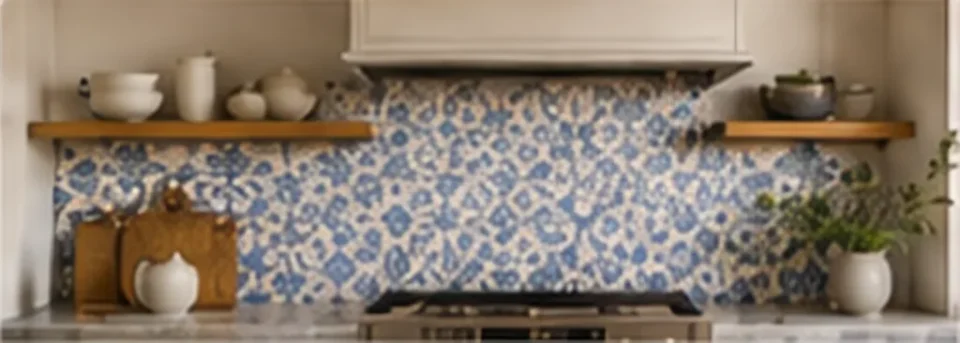
Consider how much wall will actually be visible, too. Open shelving shows far more tile than a run of wall cabinets, and a range hood or window can break the backsplash into smaller panels.
Pattern or plain?
There is no wrong answer, but each approach creates a different kind of kitchen.
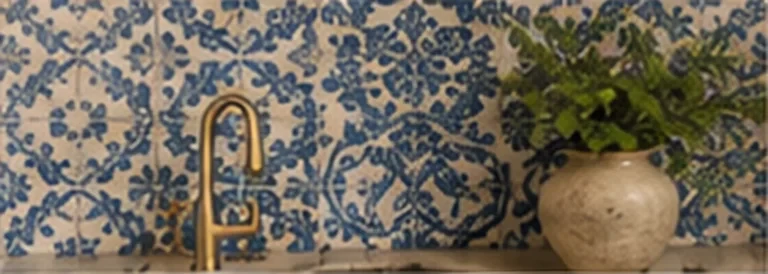
- A patterned backsplash becomes the focal point of the room. Classic blue and white designs such as Lisboa Blue bring the warmth of a traditional Portuguese kitchen, while earthier motifs like Alfama Vine suit timber cabinetry and brass.
- A plain tile gives colour and sheen without pattern. Solid glazes such as Sevilla Navy or Alentejo White suit minimal, contemporary kitchens and make a calm backdrop for open shelving.
- A combination, for example a patterned panel behind the cooktop framed by plain tiles, concentrates the impact exactly where you want it.
Size, finish and colour
Tile size
All designs are supplied as square tiles in 10 × 10, 15 × 15 and 20 × 20 cm, priced per tile with a minimum of 10 tiles of each design.
Finish
Glazed ceramic resists water and stains in any finish, so the choice is mostly about the look you want. Gloss reflects light and brightens a darker kitchen; satin offers a soft sheen; matte gives the most natural, understated surface. Behind a busy cooktop, a satin or gloss glaze is slightly quicker to wipe clean.
Colour
Pick out a colour that already exists in the kitchen, such as the veining of the countertop, the timber of the cabinets or the brass of the taps, so the backsplash feels connected to the room. Every Bassani’s design is an original by Claudio Bassani, produced by machine for consistent colour, size and finish, so the pattern reads evenly from one end of the wall to the other.
Measure and order the right quantity
Accurate ordering saves both money and delays, especially with tiles that are made to order.
- Measure the width and height of each section of wall to be tiled and multiply them to find the area. A backsplash between countertop and wall cabinets is often around 18 inches (45 cm) high, but always measure your own.
- Add the sections together and subtract large openings such as windows. Small cut-outs like electrical outlets can be ignored.
- Divide the area in square metres by 0.01 for 10 × 10 cm tiles, by 0.0225 for 15 × 15 cm tiles or by 0.04 for 20 × 20 cm tiles. Round up to a whole tile, then add an allowance for cuts and spares. Confirm the final layout and grout joints with the installer.
- Add around 10 % for cuts, breakages and future repairs. Our product pages let you order by the tile, the square metre or the square foot, and add this overage automatically.
For example, a backsplash 3 m long and 45 cm high covers 1.35 m². At 15 × 15 cm, this requires 60 tiles before cuts. A 10% allowance gives 66 tiles. Confirm the layout and grout spacing with the installer.
The finishing details that make the difference
- Where to stop. End the tile at a natural line: the edge of the countertop, the end of the wall cabinets or the ceiling. Stopping at an arbitrary point makes a backsplash look unfinished.
- Frame the panel with square accent designs. Ask your installer to specify how exposed tile edges should be finished.
- Grout. Grout that matches the tile background lets a pattern flow; a contrasting grout emphasises the grid. Near the cooktop, a mid-tone grout hides everyday marks better than bright white.
- Setting out. Centre the pattern on the most important feature, usually the cooktop or the sink, and lay the tiles out dry before fixing to check the pattern and plan every cut.
We recommend installation by an experienced tiler, using a suitable ceramic tile adhesive and grout joints of 2 to 3 mm. All Bassani’s tiles are for interior use only and are not suitable for outdoor installation. If you would like a second opinion before you commit, book a free design consultation and share photos of your kitchen and your shortlist.
Quick answers
What is the best type of tile for a kitchen backsplash?
Glazed ceramic tile is one of the most practical choices: it resists water and stains, copes with everyday kitchen heat and wipes clean easily. Beyond that, choose the pattern, size and finish that suit your kitchen’s style and light.
How many tiles do I need for a backsplash?
Divide the area in square metres by 0.01 for 10 × 10 cm tiles, by 0.0225 for 15 × 15 cm tiles or by 0.04 for 20 × 20 cm tiles. Round up to a whole tile, then add an allowance for cuts and spares. Confirm the final layout and grout joints with the installer.
How do I clean a tiled kitchen backsplash?
Wipe splashes promptly with warm water and a pH-neutral cleaner, and avoid abrasive pads or acidic products that can dull glaze and grout. Our tile care guide explains grout sealing in detail.